Home  |
Service  |
Today:
PISTON PUMP

Piston Pump Design:

A Piston Pump is a Positive Displacement Pump (PDP) with a set of piston and cylinders. As the pump rotates, the pistons, driven typically by an angled “swash” plate, change the fluid volume of the cylinders. These cylinders first expand to suck in fluid and then compress to expel the fluid at into an outlet manifold via a valve plate.

Advantages:

Positive displacement, High pressure, heavy duty applications.

Application:

Transmissions, hydraulics, fluid transfer.

Piston Pump Hardware
Piston Pump Cavitation
Piston Pump Pressure

PumpLinx: Solve Flows, Pressures, Cavitation, and Loads:

Discriminators:

  • Models cavitation
  • Able to accommodate very high pressures
  • Ability to model micron scale leak paths
  • Superior treatment of rotating-stationary interfaces
  • Ease-of-use
  • Fast turn-around

Design Issues/Benefits:

  • Cylinder head design
  • Inlet/outlet port design
  • Valve plate design
  • Leakage reduction
  • Reduce cavitation effects on efficiency and pump life
  • Reduce pressure ripple and noise


EXAMPLE: Hydraulics Piston Pump
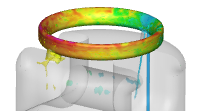
Analysis cavitation damage of a piston pump design. PumpLinx simulation predicts cavitation location on valve plate which matches perfectly with experimental results.
Piston Pump Cavitation
Home      |      Company      |      Products      |      Services      |      Support      |      Contacts      |      Careers
Copyright © Simerics Inc., 2006-2008.